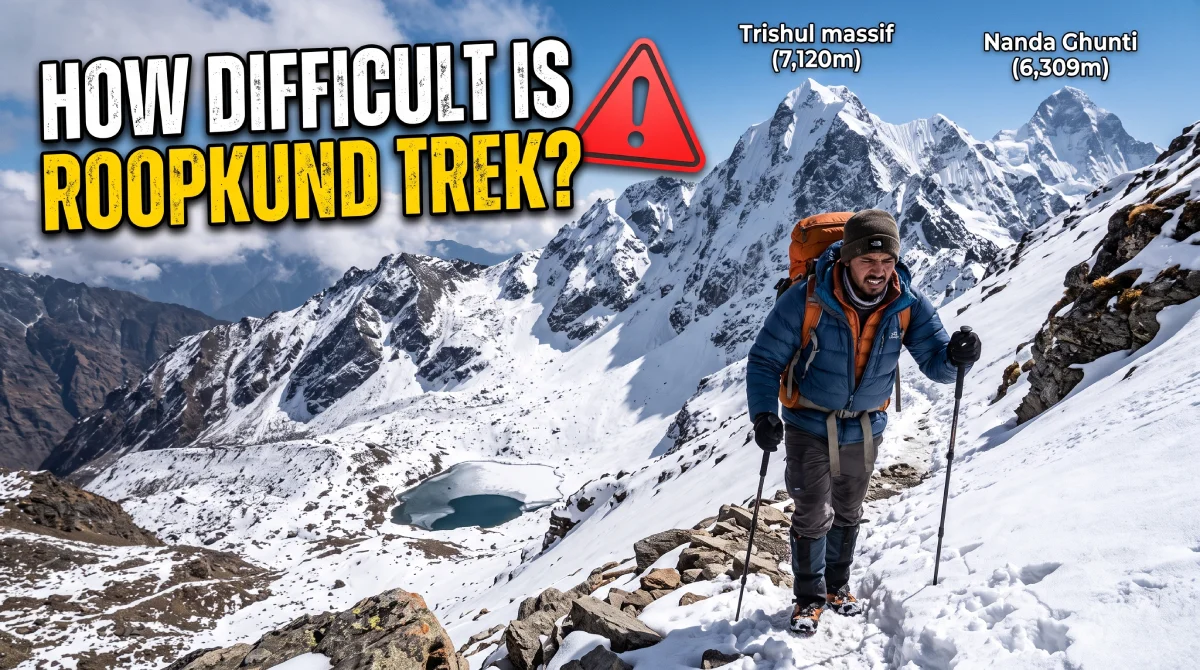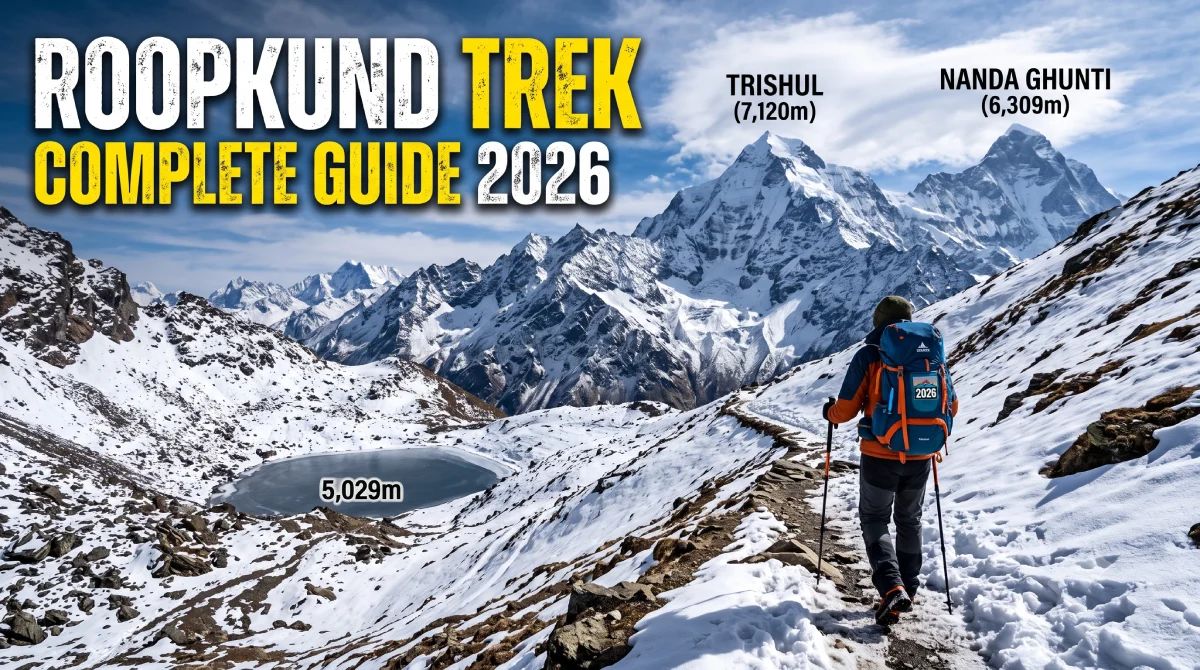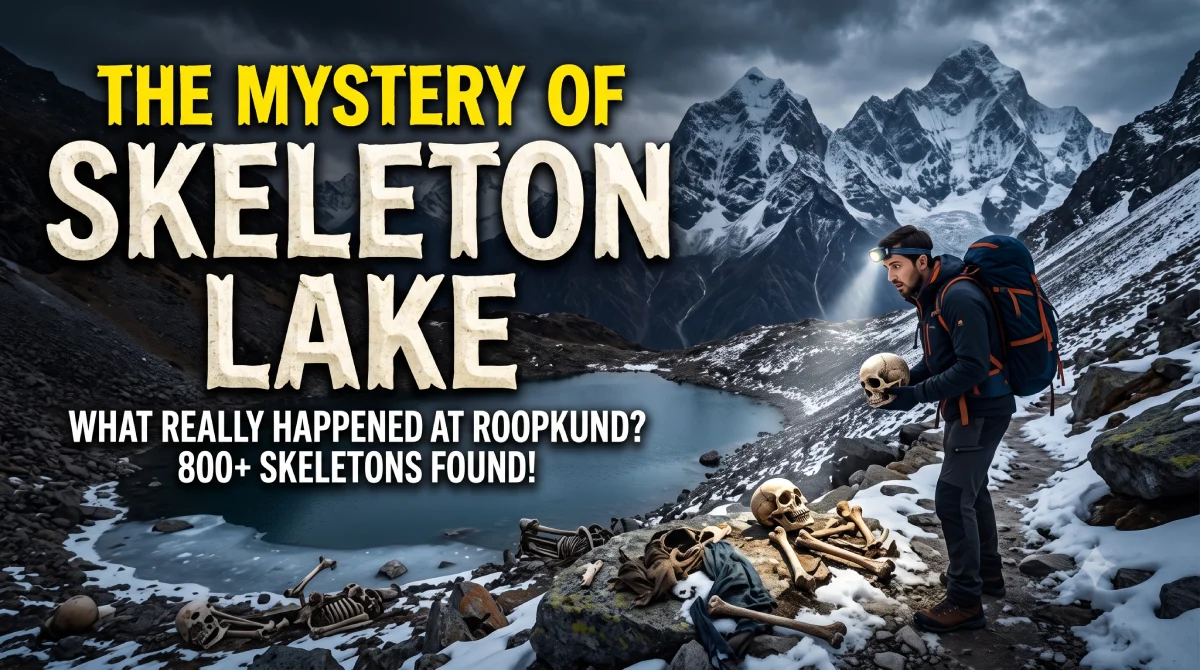
High in the mountains of Uttarakhand, at an altitude of nearly 5,000 metres, lies a small glacial lake surrounded by snow-covered peaks. Known as Roopkund Lake, this remote Himalayan lake has become famous around the world for a remarkable and unsettling reason: human skeletal remains have been found around its shores.
Because of these remains, Roopkund is popularly known as “Skeleton Lake.”
For decades, the discovery of hundreds of human bones at such a remote and inhospitable location led to numerous theories. Were the people victims of a mysterious epidemic? Did they die in a battle? Was the lake connected to an ancient ritual or pilgrimage?
Modern scientific research has helped answer some of these questions—but it has also made the story more fascinating.
In this article, we explore the mystery of Skeleton Lake, what scientists discovered about the remains, the theories surrounding their deaths, and why Roopkund continues to attract trekkers, historians, and researchers.
Where Is Skeleton Lake?
Skeleton Lake is another name for Roopkund Lake, located in the Chamoli district of Uttarakhand in northern India.
The lake sits in a remote high-altitude region of the Himalayas and is surrounded by rugged mountain terrain. It is accessible by trekking routes that pass through forests, alpine meadows, and increasingly barren high-altitude landscapes.
The remote location is one of the reasons the discovery of human remains at Roopkund was so surprising.
Why Is Roopkund Called Skeleton Lake?
Roopkund earned the nickname Skeleton Lake because human skeletal remains have been found in and around the lake.
When the snow and ice around the lake recede, bones can become visible along the shoreline. Historical reports and later investigations revealed that the remains belonged to numerous individuals.
The sight of human bones scattered around a high-altitude Himalayan lake naturally inspired stories and speculation about what happened to these people.
For many years, however, there was no definitive explanation.
How Were the Skeletons Discovered?
The exact circumstances of the earliest discovery are not completely straightforward, but the remains became known to authorities and researchers during the 20th century.
The isolated location of Roopkund meant that the discovery generated considerable interest. Researchers began examining the bones and considering possible explanations for how so many people could have died in the same region.
The mystery became even more intriguing because the remains did not appear to belong to a single recent event that could be easily explained.
Theories Behind the Mystery of Skeleton Lake
Over the years, several theories have been proposed to explain the deaths at Roopkund.
1. A Severe Hailstorm
One of the most famous theories suggested that a group of travellers was caught in an extreme hailstorm.
The idea gained attention because some of the skulls and bones appeared to show evidence consistent with powerful impacts.
According to this theory, large hailstones may have caused fatal injuries to people who had little protection in the exposed mountain landscape.
This became one of the most popular explanations for the mystery.
2. An Epidemic
Another theory suggested that the group may have died from an infectious disease or epidemic.
Because a large number of people appeared to have died in the same general area, researchers considered whether disease could have been responsible.
However, later scientific research complicated the idea that all the individuals died from a single event.
3. A Battle
Another possibility was that the skeletons belonged to people who died during a conflict.
The remote Himalayan location and the absence of a clear historical record encouraged speculation about whether the remains might be connected to a battle or violent encounter.
There is, however, no simple historical evidence establishing that the entire group died in a battle.
4. A Pilgrimage Gone Wrong
One long-standing interpretation connects Roopkund with ancient pilgrimage routes and religious journeys through the Himalayas.
The Nanda Devi region has a long association with local traditions and pilgrimage.
Some researchers have suggested that groups travelling through the mountains may have encountered extreme weather or other dangerous conditions.
This possibility is particularly interesting because it connects the scientific mystery with the cultural history of the region.
What Did Scientists Discover?
The story took a major turn when scientists began using modern techniques to study the remains.
Researchers examined DNA and used radiocarbon dating to determine the approximate ages of the bones.
Instead of revealing one simple event, the research suggested a much more complicated story.
Studies indicated that the remains did not all come from people who died at exactly the same time.
Even more surprisingly, genetic analysis suggested that some individuals had ancestry associated with different geographic populations.
This finding challenged the idea that all the people at Roopkund belonged to one local group.
The Mystery Became More Complicated
A major scientific study published in 2019 analyzed genetic material from numerous Roopkund skeletons.
The research found evidence of multiple distinct groups of individuals.
Some individuals had genetic ancestry associated with South Asia, while others showed ancestry connected to populations from the eastern Mediterranean region.
The dating evidence also indicated that these individuals did not necessarily die during one single historical event.
This was a major development in the Skeleton Lake mystery.
Instead of asking only:
“What happened to this group of people?”
researchers now had to consider another question:
“Why did people from different populations end up at Roopkund at different times?”
Were the Skeletons From One Disaster?
The scientific evidence suggests that the answer may be no.
The remains appear to represent people who died during different periods.
Some individuals are estimated to have died roughly 1,000 years ago, while others appear to date to considerably later periods.
This means the famous image of one large group suddenly dying at the lake may not tell the whole story.
Roopkund may have witnessed multiple episodes of death over a long period of time.
Why Were People at Such a High Altitude?
This remains one of the fascinating questions surrounding Skeleton Lake.
Roopkund lies in an extremely challenging Himalayan environment. Why would people travel to such a remote and high-altitude location?
One possible explanation is pilgrimage.
The wider region has strong cultural and religious connections, particularly with traditions associated with Nanda Devi.
Seasonal journeys through the mountains may have brought groups of people into high-altitude areas.
However, researchers continue to investigate exactly how and why different populations reached Roopkund.
The Role of Climate and Extreme Weather
The Himalayan environment is another important part of the mystery.
At nearly 5,000 metres, weather conditions can change rapidly. Snowstorms, freezing temperatures, high winds, and other hazards can make travel extremely dangerous.
Even today, experienced trekkers must respect the risks associated with high-altitude Himalayan terrain.
For historical travellers without modern equipment, navigation, weather forecasting, or protective clothing, the environment would have been considerably more challenging.
Why Is Skeleton Lake So Fascinating?
The mystery of Roopkund is not simply about human remains.
It brings together several different subjects:
-
Himalayan geography
-
Ancient migration
-
Climate and extreme weather
-
Archaeology
-
Genetics
-
Local culture
-
Religious traditions
-
High-altitude travel
-
Human history
Every scientific discovery has answered some questions while creating new ones.
That combination is what makes Roopkund one of the most intriguing archaeological mysteries in the Himalayas.
Roopkund and the Nanda Devi Tradition
The region around Roopkund has deep cultural significance.
The Nanda Devi Raj Jat is a traditional pilgrimage associated with the goddess Nanda Devi and the mountainous region of Uttarakhand.
The connection between Roopkund and pilgrimage has been discussed in research and popular accounts of the lake. However, it is important not to assume that every skeleton found at Roopkund belonged to pilgrims.
Scientific evidence indicates that the remains represent people from different periods and backgrounds.
The cultural history of the region therefore provides important context, but it does not by itself solve the entire mystery.
Can You Visit Skeleton Lake?
Roopkund has historically been a popular destination for experienced Himalayan trekkers.
The journey to the lake involves high-altitude trekking through challenging terrain. However, access to Himalayan trekking areas can change because of environmental concerns, government regulations, local restrictions, weather, and conservation requirements.
Anyone planning a Roopkund trek should therefore check the latest official information about route accessibility and permissions rather than relying solely on older travel blogs or trekking itineraries.
Is Roopkund Trek Difficult?
Yes, the Roopkund route is considered a challenging high-altitude trek.
The combination of steep climbs, long walking days, high elevation, unpredictable mountain weather, and potentially snow-covered terrain makes physical preparation important.
The lake itself is located at roughly 5,000 metres, where altitude becomes a significant factor.
Trekkers should have good endurance, prepare properly, and understand the risks associated with high-altitude environments.
What Makes the Mystery of Roopkund Unique?
Many archaeological discoveries tell us about a particular historical event.
Roopkund is different.
The remains appear to represent people from different periods and different genetic backgrounds, making the site more like a long-term record of human presence and death in an extreme Himalayan environment.
The lake therefore raises questions that go beyond a single disaster.
Who were these people?
Where did they come from?
Why did they travel into this remote region?
What happened to them?
And why did some groups appear at Roopkund centuries apart?
Some answers have emerged through modern science, but the complete story remains complex.
Final Thoughts: The Mystery of Skeleton Lake
The Mystery of Skeleton Lake is one of the most intriguing stories associated with the Himalayas.
For decades, Roopkund was surrounded by theories about a mysterious disaster. Modern genetic research and radiocarbon dating have shown that the reality is more complicated than the idea of one group dying together in a single catastrophic event.
Evidence indicates that the remains represent multiple groups and different periods, with some individuals having ancestry from regions far beyond the Himalayas.
Yet important questions remain.
Perhaps that is what makes Roopkund so fascinating. The lake is not simply a destination for trekkers—it is also a window into ancient human movement, Himalayan culture, environmental hazards, and the mysteries that can survive for centuries in remote landscapes.
Roopkund, the Skeleton Lake of Uttarakhand, continues to remind us that sometimes the deeper we look into history, the more questions we discover.
Frequently Asked Questions About Skeleton Lake
Why is Roopkund called Skeleton Lake?
Roopkund is called Skeleton Lake because numerous human skeletal remains have been discovered around the lake and become visible when snow and ice recede.
Where is Skeleton Lake located?
Skeleton Lake, or Roopkund Lake, is located in the Chamoli region of Uttarakhand in the Indian Himalayas, at an altitude of approximately 5,000 metres.
How old are the Roopkund skeletons?
Scientific dating indicates that the remains do not all belong to the same period. Some individuals died roughly 1,000 years ago, while others date to later periods.
What caused the deaths at Roopkund?
There is no single confirmed explanation for all the deaths. Research suggests that the remains represent multiple groups and different periods, meaning there may have been more than one cause or event.
Were the Roopkund skeletons from one group?
No. Genetic research has indicated that the remains include individuals with different genetic ancestries and that they did not all die during the same period.
Was Roopkund caused by a hailstorm?
A severe hailstorm has been proposed as one possible explanation for some deaths, but modern research indicates that the overall story of Roopkund is more complex than a single disaster.
Can you trek to Roopkund Lake?
Access to Roopkund can be affected by current regulations, environmental concerns, weather, and local conditions. Check the latest official information before planning a trek.